Birds of East Africa

Tanzania

Tanzania's bird list runs past 1,100 species, with northern Tanzania holding several birds found nowhere else on Earth alongside classic Rift Valley lake spectacles. These are the ones travelers on Hudhud's Tanzania itineraries ask about most.

Best time for birding

Seasonality

Northern Tanzania birds well in every month. Palearctic migrants are present roughly October to April, and the calving season on the southern Serengeti plains (roughly December to March) coincides with excellent grassland birding. Rains fall mainly in November and from March to May, which can affect some road access. We match the route to the season and to what you most want to see.

Most popular birds

8 birds to know before you go

Fischer's Lovebird

Fischer's Lovebird

Agapornis fischeri

A small, stocky parrot: green body, orange-red face fading to yellow on the nape, and a bright red bill. Near-endemic to north-central Tanzania, common around Lake Manyara and the Serengeti's woodland edges, usually in noisy flocks.

Photo: Wikimedia Commons

View live sightings on eBird →

Grey-breasted Spurfowl

Pternistis rufopictus

A large grey-and-brown francolin found only in Tanzania, with bare red skin on the throat and around the eyes, a red bill, and chestnut-buff-black markings along the flanks. Found in dry thorn savanna and woodland around the Serengeti and Ngorongoro highlands, usually in pairs or small groups.

View live sightings on eBird →

Rufous-tailed Weaver

Histurgops ruficauda

An unusual weaver endemic to northern Tanzania's dry country, with pale blue eyes, a heavily streaked brown body, and a rufous tail. Forms noisy, active flocks around Serengeti and Tarangire, often near acacia woodland.

View live sightings on eBird →

Ashy Starling

Lamprotornis unicolor

A plain, uniformly grey-brown starling with a notably long tail — unusual among East Africa's often gaudy starlings. Endemic to northern Tanzania's dry savanna, common around Tarangire National Park and the Maasai Steppe.

View live sightings on eBird →
Kori Bustard

Kori Bustard

Ardeotis kori

Africa's heaviest flying bird: a large, long-legged bustard with a black-and-white checkered wing pattern and a grey, finely-vermiculated neck and crest. Walks steadily through open grassland and savanna, rarely flying unless disturbed.

Photo: Wikimedia Commons

View live sightings on eBird →
Southern Ground Hornbill

Southern Ground Hornbill

Bucorvus leadbeateri

An enormous, mostly black, ground-dwelling hornbill with bright red facial and throat skin (blue in the center for females). Walks in small family groups across grassland, hunting insects, small reptiles, and rodents on foot.

Photo: Wikimedia Commons

View live sightings on eBird →

Silvery-cheeked Hornbill

Bycanistes brevis

A large black-and-white hornbill with a pale, oversized casque atop the bill, larger in males. Found in forest and forest-edge habitat at higher elevations, including the Ngorongoro Highlands, often seen in fruiting fig trees.

View live sightings on eBird →
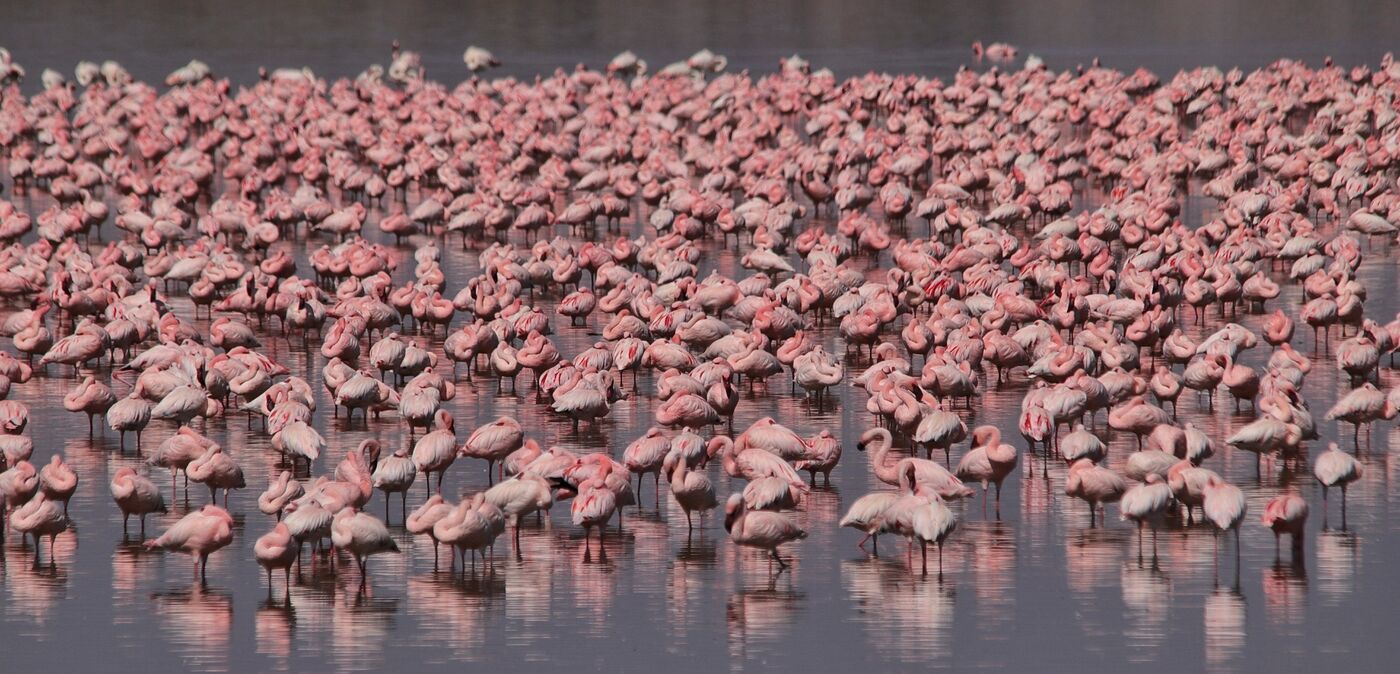
Lesser Flamingos massed on a Rift Valley lake, photographed on a Hudhud trip

Lesser Flamingo

Phoeniconaias minor

The smallest flamingo species, feeding on cyanobacteria in alkaline lakes. Lake Natron, in northern Tanzania, is the single most important breeding site for the species in East Africa, alongside non-breeding flocks at Lake Manyara.

View live sightings on eBird →

Data: eBird / Cornell Lab of Ornithology. Field marks and range notes checked against eBird species accounts and Birds of the World before publishing.

Birding is part of every Hudhud safari

Ask us about birding-focused itineraries in Tanzania.

Ask us about birding trips Browse itineraries